
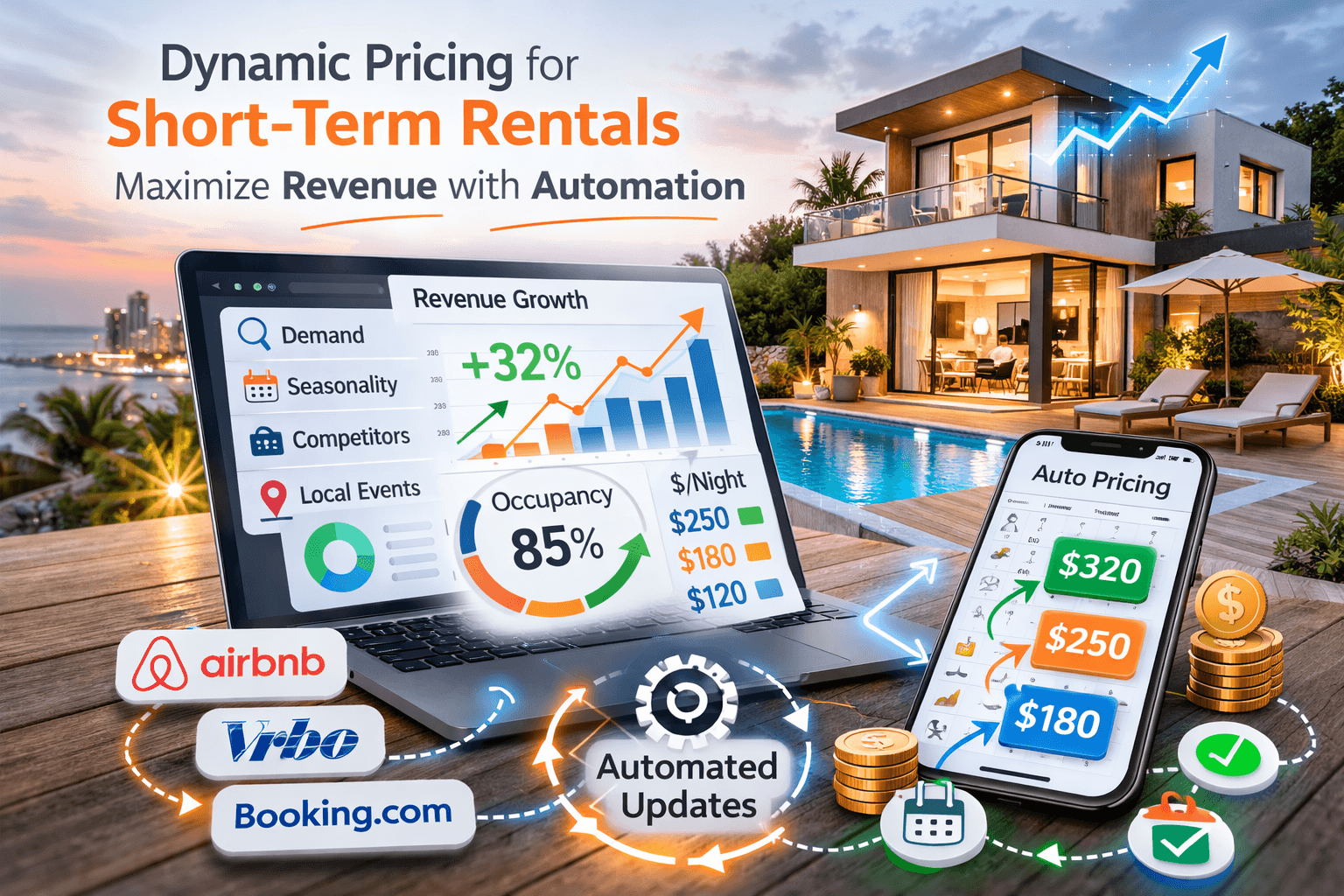
Using dynamic pricing for short-term rentals increases overall profit.
Static pricing limits income in short-term rentals. Many hosts set one rate and rarely adjust it. However, demand changes every day. Because of this, manual pricing often leaves money on the table. Instead of guessing, the system adjusts rates automatically. As a result, your property earns closer to what the market allows.
What Is Dynamic Pricing?
Dynamic pricing adjusts nightly rates based on market conditions. These include:
- Demand levels
- Seasonality
- Competitor pricing
- Local events
- Booking pace
- Time until arrival
According to Investopedia, dynamic pricing changes rates in response to real-time supply and demand. In short-term rentals, this means prices rise during high demand and drop during slow periods.
Therefore, pricing becomes data-driven instead of emotional.
Why Static Pricing Fails
Static pricing creates two main problems.
First, you underprice peak dates. For example, holidays and major events increase demand quickly. If your price stays fixed, you lose potential revenue.
Second, you overprice slow nights. When demand drops, high rates reduce occupancy. As a result, empty nights generate zero income.
Dynamic pricing balances rate and occupancy. Instead of maximizing nightly price, it maximizes total revenue.
Real Market Data on Revenue Impact
Market research shows clear results.
AirDNA reports that professional operators who use data-driven pricing outperform casual hosts in both revenue and occupancy. In addition, industry case studies suggest revenue increases of 15% to 35% after implementing automated pricing tools.
These gains usually come from two factors. First, properties capture higher rates during peak demand. Second, they maintain occupancy during slow seasons.
Therefore, automation improves both sides of the revenue equation.
How Dynamic Pricing Tools Work
Pricing tools collect and analyze large amounts of data. These systems monitor:
- Local listing supply
- Competing nightly rates
- Historical booking trends
- Lead time before check-in
- Day-of-week demand
- Special events
Then, the system updates your rates automatically across Airbnb, Vrbo, and other platforms.
Because of this, prices react in real time. Meanwhile, you avoid daily manual adjustments.
Dynamic Pricing Tool Comparison (2026)
Below is a practical comparison of leading tools used by short-term rental operators.
PriceLabs
PriceLabs is one of the most widely used revenue management tools.
Key features:
- Custom pricing rules
- Minimum and maximum rate controls
- Event-based adjustments
- Portfolio dashboards
Pricing model: subscription, starting around $20 per listing per month.
Best for: Hosts who want detailed control.
Website: https://hello.pricelabs.co
Beyond (formerly Beyond Pricing)
Beyond uses demand-based automation. It adjusts prices automatically using market signals.
Key features:
- Real-time demand tracking
- Event detection
- Market benchmarking
Pricing model: performance-based, usually around 1% of booking revenue.
Best for: Hosts who prefer a simple, set-and-forget system.
Website: https://www.beyondpricing.com
Wheelhouse
Wheelhouse combines automation with strategy customization.
Key features:
- Adjustable pricing strategies
- Portfolio analytics
- Market comparison tools
Pricing model: flexible subscription or performance pricing.
Best for: Growing portfolios.
Website: https://www.usewheelhouse.com
Airbnb Smart Pricing
Airbnb offers built-in automated pricing.
Key features:
- Free integration
- Platform-native automation
However, it only works inside Airbnb. Therefore, it lacks cross-platform optimization.
Best for: Beginners with one listing.
You can read more about what people have to say about Airbnb Smart pricing in this reddit article.
Regional Considerations
Pricing dynamics differ by region.
In the United States, competition is high in major cities. Therefore, automation is almost mandatory.
In Canada, strong seasonality creates sharp rate swings. Because of this, automated pricing captures summer peaks and winter lows more effectively.
In Mexico, tourism-driven markets experience event-based spikes. As a result, automated tools help capture holiday demand.
In Europe, historic city centers and regulations affect supply. Therefore, pricing tools must adjust quickly to changing inventory levels.
Manual Pricing vs Automated Pricing
Manual pricing reacts slowly. Automated pricing reacts immediately.
Manual pricing uses limited data. Automated pricing uses large datasets.
Manual pricing often includes emotional bias. Automated pricing removes that bias.
As a result, automated systems scale better, especially for multiple properties.
Common Pricing Mistakes
Even automation requires correct setup.
First, setting a high minimum rate can block bookings. Therefore, revenue floors should be realistic.
Second, ignoring local events can reduce peak earnings. Because of this, some manual oversight is still useful.
Third, failing to monitor booking pace can distort rates.
Automation works best when paired with strategy.
How Pricing Automation Fits Into Full Rental Automation
Pricing is one layer of a broader automation system.
It connects with:
- Channel managers
- Booking engines
- Analytics dashboards
- Cleaning schedules
For example, when occupancy rises, cleaning frequency increases. Likewise, when demand spikes, rates adjust automatically.
Therefore, pricing automation supports the entire operational ecosystem.
Final Thoughts
Dynamic pricing is not about charging more. Instead, it is about charging correctly.
Markets move daily. Manual pricing cannot keep up.
However, revenue automation adapts continuously. As a result, your property performs closer to its true potential.
If you manage one property, automation saves time. If you manage multiple properties, it becomes essential.
In short, pricing automation transforms short-term rentals from reactive operations into structured revenue systems.